Botany Major
The botany major provides an introduction to the living world: the diversity of its organisms, its historical origins through evolution, its principles of structure, function, and ecology, and its interactions with the nonliving world.
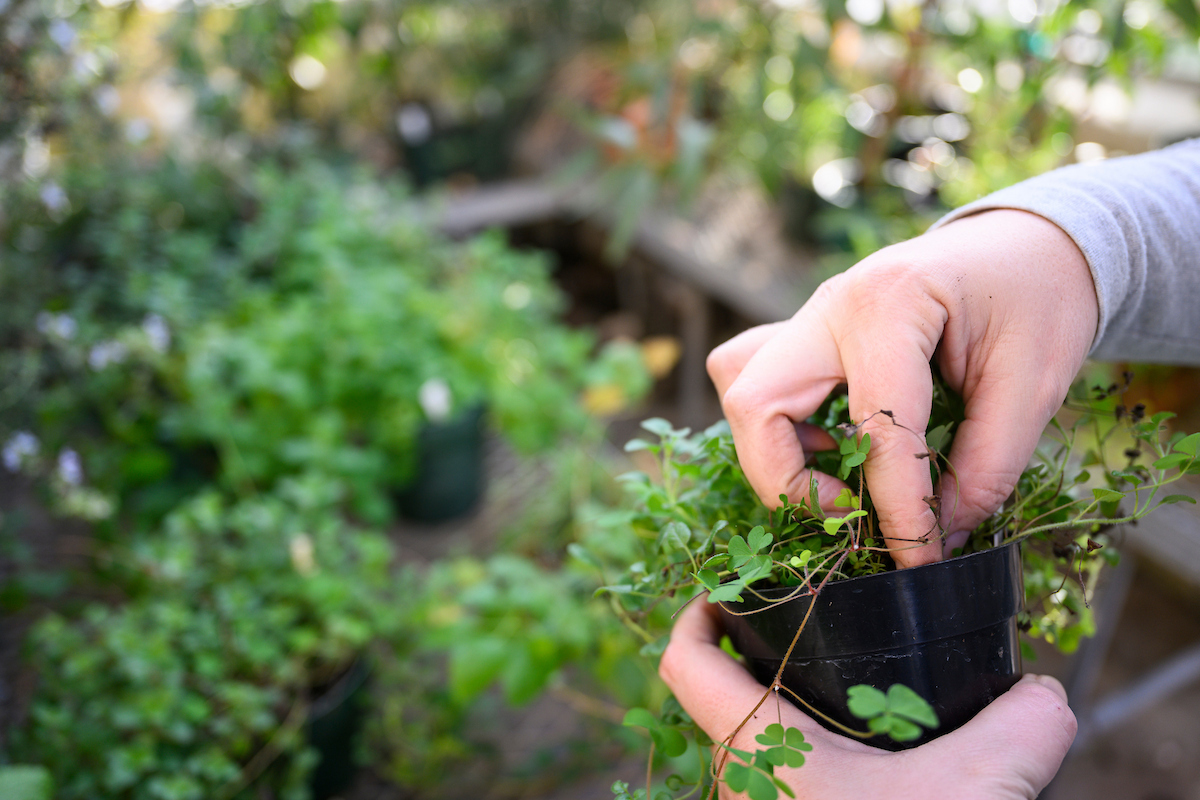
Faculty members investigate plants, algae, fungi and bacteria, and are authorities in aspects of plant biology ranging from molecular functions in cells to behavior of ecosystems.
The required independent research project cultivates a strong relationship between a student and their faculty mentor while providing an extended hands-on learning opportunity that is rare in other programs.
Requirements
In addition to fulfilling university and L&S requirements, students must fulfill the following requirements for the Botany major and an independent research project:
The total number of credits in Biology, Botany and Independent Research must equal at least 30.
Advising and Declaration
Prospective botany majors should consult with the undergraduate botany advisor by the beginning of their junior year to outline an appropriate course of study.
To be accepted as a major in botany, a student must have a GPA of 2.5 for all science courses taken during the freshman and sophomore years.
How to Declare:
- All students interested in the Botany major can schedule an advising session with Mark Connolly.
- This meeting will cover general information about the major and botany research areas students can study.
- Select your research area from the three below.
Dive into the taxonomy and evolution of various plant lineages, statewide floristics, tropical fieldwork, herbarium curation, methods and theory of phylogenetic reconstruction, and the interplay among evolution, ecology, biogeography, and development.
Systematics is a synthetic science that employs multiple lines of evidence to develop systems of nomenclature, classification, monographs, floristic inventories, and hypotheses of phylogenetic relationships.
The process of evolution and mechanisms of speciation are the ultimate driving forces leading to the diversity of life.
Faculty members include: David Baum, Kenneth Cameron, Eve Emshwiller Chris Muir, Anne Pringle
Analyze the basis for ecological and evolutionary patterns in plant life history, adaptive morphology, and community structure. Learn about the selective forces that may underlie these patterns and the empirical trends they generate at various scales.
Faculty members in this area have specific interests in biomechanics, physiological ecology, plant hydraulics, economic analyses of plant form, pollination biology, evolution and genetics of mating systems, plant-animal and plant-fungal interactions, ecological genetics, ordination and classification of communities, hierarchy theory, restoration ecology, and conservation biology.
Faculty members include: Sara Hotchkiss, Kennth Keefover-Ring, Daijiang Li, Kate McCulloch, Chris Muir, Anne Pringle
Study the mechanisms that produce and control plant growth and development.
Faculty members in this area employ model research species Arabidopsis, maize, and rice to investigate several processes from ranging across the plant life cycle from seed germination to flowering with all manner of modern molecular, genetic, biochemical, physiological, and microscopy techniques.
Faculty members include: Simon Gilroy, Shan He, Hiroshi Maeda, Marisa Otegui, Jack Satterlee
- When students declare, they are assigned a faculty advisor and an advisory team.
- Advisory teams are comprised of a faculty advisor, the student services coordinator, the student’s senior thesis mentor (if different from assigned faculty advisor) and the chair of the curriculum committee.
Advising
Students should discuss academic and/or research plans with their faculty advisor.
It is recommended that students meet with their advisor once a semester to plan for courses and check degree progress.
Independent Research Requirement
Writing a thesis or report based on original research can be one of the most valuable experiences of an undergraduate career. That’s why all undergraduates majoring in Botany are required to write a senior thesis or report based on original plant-focused research.
The projects provide an opportunity for extensive, one-on-one contact with a faculty member, as well as first-hand experience with the nature of scientific research. For some students it may serve as a stepping stone to graduate school and a scientific career.
A senior thesis is a large, independent research project that students take on during their senior year of college to fulfill their graduation requirement. It is the culminating work of their studies at a particular institution, and it represents their ability to conduct research and write effectively.
Students must arrange to have one of the Botany faculty either supervise their project or be willing to grade a project done under the guidance of an approved mentor elsewhere.
Choose One of the following:
- Senior Thesis
- Students enroll in either:
- 4-6 credits of Senior Thesis (Botany 691 and 692)
- 6 credits of Senior Honors Thesis (Botany 681 and 682) over a period of 2 semesters, typically in their senior year.
- Students enroll in either:
- Directed Study
- Students enroll in a minimum of 3 credits of Directed Study (Botany 699) over a period of 1 or 2 semesters, typically during their last 3 semesters.
- Botany Field Research Course.
- Students enroll in an occasionally offered field course (such as the capstone Botany 575 course) that has independent plant-focused research and intensive writing components.
- Independent Research Outside of Botany.
- Students enroll in independent, plant-focused research or thesis courses from other departments or universities (if studying abroad).
- The student is required to check with Senior Thesis Coordinator (David Baum) about the suitability of the course to fulfill research experience for the Botany major.
To receive research credits in the Botany major, you must fill out a research plan and submit it to the Student Services Coordinator to receive permission to enroll in appropriate courses.
Research plans must be submitted by the first week of school to be able to enroll by the college enrollment deadline. Access the research plan document and instructions here.
The student services coordinator will process the research plan and notify the student via email that they can enroll in the research section and level specified.
It is the student’s responsibility to ensure that they have enrolled in the course. Students can verify their enrollment by reviewing their DARS or their course schedule.
For a course to count toward the research requirement it must include ALL of the following:
- The course must involve writing a substantial paper or report that is deposited with the student services coordinator.
- The course must be at least three credits.
- The course must involve original, independent, botanically focused research in the lab or field.
Credits are based on the calculation that for every credit received a student must produce 3 hours or more per week over the semester using a fifteen week semester calculation (i.e. 2 credits x 3 hours per week x 15 weeks = 90 hours (minimum)).
The report or thesis should have a cover page with the title, date of submission and the signature of your faculty advisor. See below for more formatting instructions.
The faculty mentor may permit, in lieu of a written report, the depositing of a powerpoint presentation (with details of hypothesis, methods, results, discussion) given at a lab meeting or conference.
The final written thesis or report must be signed by faculty research mentor and electronically submitted to the student services coordinator (Mark Connolly) and thesis advisor by the end of the student’s final semester.
- The research thesis or report is to have one-inch margins and double spaced.
- If you expect to publish in a particular journal, follow the format prescribed by the journal.
- Consult with your senior thesis advisor for his/her preferred style. If your mentor does not have a preferred style, use the requirements for the journal Science.
- The final thesis or report must include a cover page signed by the students faculty advisor.
There are a number of funding opportunities available to undergraduates to help support research projects.
The Grants Information Center in Memorial Library has sources of information on scholarships, loans and grants available to individuals.
Some funding programs available:
Hilldale & Holstrom Undergraduate/Faculty Research Fellowship
The Hilldale Undergraduate/Faculty Research Fellowships support undergraduate research done in collaboration with UW–Madison faculty or research/instructional academic staff. Approximately 97 – 100 Hilldale awards are available each year.
Deadline is usually in February each year.
University Book Store Academic Excellence Award
Supported by a generous grant from the University Book Store, this award recognizes undergraduate students who have completed an outstanding independent project, such as a senior thesis, at the University of Wisconsin–Madison. Projects in all academic fields are eligible.
Deadline is usually in the beginning of March each year.
How do I pick a senior thesis topic?
Consider:
- discussing possibilities with a faculty member or TA who taught courses that you found interesting.
- Attending a Colloquium or talk to find faculty interests and possible project topics.
- Review the research areas above and associated faculty members.
When should I start thinking about fulfilling this requirement?
Students should begin planning as soon as possible but no later than their first semester of their junior year. If given enough time, a faculty member may be able to help secure funding through one of the funding sources listed.
How do I get in touch with a faculty member?
Students can write faculty a letter of introduction via email. A letter can include a student’s research interests, prior coursework, relevant work experiences, availability (hours/week) and intended timeline for completing the research.
Follow-up by visiting their office hours, by phone or additional email.
Can I complete this requirement over the summer?
Only one semester of senior thesis may be taken during the summer 8-week session. However, to receive the same amount of credit as a regular semester, students must complete the same number of hours.
For example, two credits in a regular semester is a minimum of 90 hours. In the summer, students would still need to complete a least 90 hours of research, but in an 8 week session.
I wanted to spend a semester during my senior year abroad, can I complete my requirement while overseas?
Yes. Students must plan ahead by choosing the program or university abroad, discussing the program with the study abroad advisors and talking to the Senior Thesis Coordinator (Prof. David Baum) about approvals.
Career Planning
Graduates from the botany major find jobs in areas like:
- ecology
- research
- education
- government and public service
- and often continue their education in graduate or professional school.
You can schedule an appointment with your advisor to discuss careers you can build with a botany major.
SuccessWorks is the College of Letters and Science’s office dedicated to helping students develop their careers before they graduate. Explore their extensive resources and schedule an appointment to develop your career.
Forms
Necessary forms related to the Integrative Biology Graduate program are available at the link below.